


Diagnostic Dental Instruments Australia: Complete Guide to Dental Examination Instruments, Mouth Mirrors, Explorers, Tweezers & Instrument Sets (2026 Buyer’s Guide)

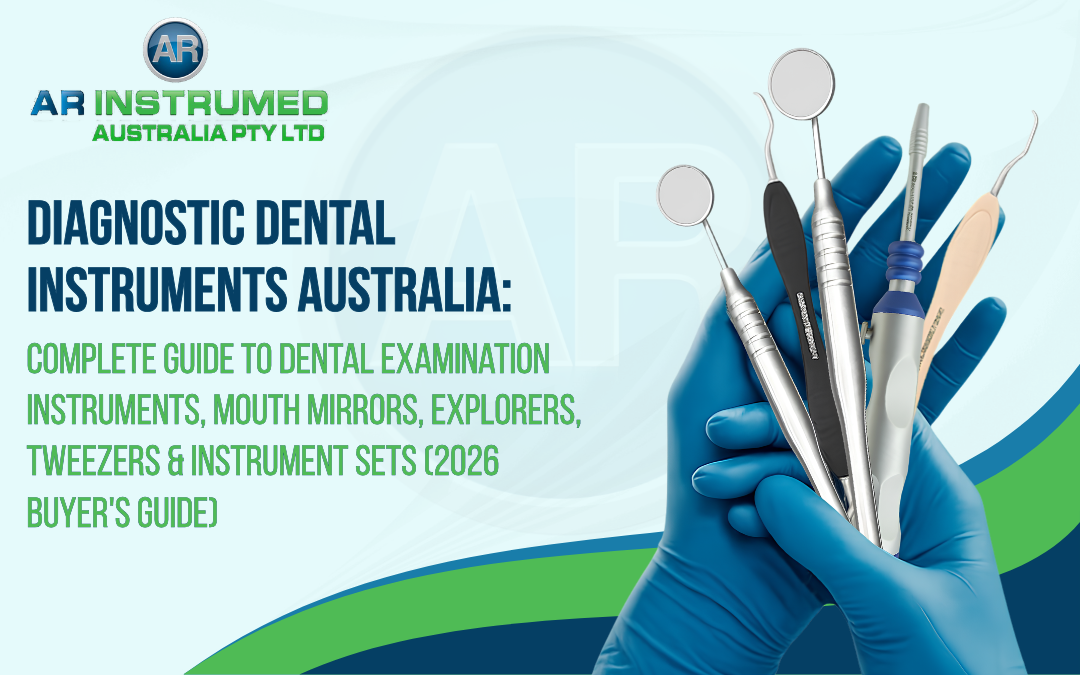
Quick Answer: Diagnostic dental instruments are the hand tools dentists use to examine, assess, and diagnose oral conditions before any treatment begins. The core set includes a mouth mirror, dental explorer (probe), and college tweezers, often supplied together as a complete dental examination set. In Australia, clinics rely on AR Instrumed Australia for corrosion-resistant, surgical-grade stainless steel instruments that meet AS/NZS sterilization standards and hold up to daily autoclave cycles.
If you're a dentist, clinic owner, procurement manager, or distributor sourcing reliable diagnostic instruments in Australia, this guide covers everything you need — instrument types, buying criteria, sterilization best practices, and how to get bulk or wholesale pricing.
What Are Diagnostic Dental Instruments?
Diagnostic dental instruments are hand-held clinical tools used during the initial examination phase of dental treatment. Before a filling, extraction, or root canal ever begins, a dentist uses these instruments to visually and tactilely assess a patient’s teeth, gums, and oral tissue.
The three foundational diagnostic dental instruments are:
- Mouth mirror for indirect vision, retraction, and light reflection
- Dental explorer (probe) for detecting caries, calculus, and irregularities in tooth structure
- Dental tweezers (cotton pliers) for placing and retrieving small items intraorally
Together, these three tools form the backbone of every dental examination set, and they’re typically the first instruments touched during any patient appointment from routine check-ups to complex diagnostic workups at dental hospitals and university clinics.
Why High-Quality Diagnostic Instruments Matter
A diagnostic instrument might seem simple compared to surgical or implant tools, but its precision directly affects clinical accuracy. Poor-quality instruments create real problems:
- Missed diagnoses a dull or poorly-angled explorer tip can miss early-stage caries
- Corrosion and staining low-grade steel pits and rusts after repeated autoclaving, harbouring bacteria
- Patient discomfort rough mirror edges or misaligned tweezers reduce chairside comfort
- Instrument failure mid-procedure cheap tweezers with weak tension lose grip on cotton rolls or small materials
- Higher long-term cost instruments that need replacing every few months cost more than a single premium purchase
For Australian dental clinics and hospitals working through high daily patient volumes, instrument reliability isn’t a luxury it’s part of clinical risk management. This is why practice owners and procurement managers increasingly standardise on a single trusted dental instrument supplier in Australia rather than mixing cheap imports with premium tools.
Complete List of Diagnostic Dental Instruments
A standard diagnostic dental instruments range includes:
- Mouth mirrors (plain, front-surface, magnifying)
- Mirror handles (simple stem, cone socket)
- Dental explorers (single-end, double-end, straight, curved)
- Periodontal probes (graduated, colour-coded, WHO probe)
- College tweezers (locking and non-locking)
- Cotton pliers
- Mouth props and retractors
- Complete dental examination sets (mirror + explorer + tweezers, boxed)
Most Australian clinics purchase these as part of a dental instrument set, then supplement with individual replacement pieces as tips wear or handles are lost something worth planning for when you [explore our instrument sets range].
Mouth Mirrors: Types, Features, Benefits and Buying Tips
The dental mouth mirror is arguably the most-used instrument in any surgery. It allows indirect vision of areas the naked eye can’t reach the lingual surfaces of molars, subgingival margins, and the posterior oral cavity while also retracting cheeks, tongue, and lips and reflecting light onto the treatment area.
Types of Mouth Mirrors
- Plain (flat) mirrors affordable, standard image clarity
- Front-surface mirrors reflect light directly off the glass surface, eliminating the “double image” or ghosting effect seen in plain mirrors, giving sharper diagnostic accuracy
- Magnifying mirrors concave surface enlarges the reflected image, useful for detailed caries detection
- Rhodium-coated / photo-quality mirrors resist scratching and tarnishing over years of sterilization cycles
Mouth Mirror Comparison Table
| Mirror Type | Image Quality | Best For | Durability |
|---|---|---|---|
| Plain mirror | Standard | General examinations | Moderate |
| Front-surface mirror | High (no ghosting) | Precision diagnostics | High |
| Magnifying mirror | Enlarged image | Caries/crack detection | High |
| Rhodium-coated mirror | Premium clarity | High-volume clinics | Very high |
Buying Tips
- Choose front-surface glass for diagnostic accuracy over cheaper plain mirrors
- Match mirror head sizes (No. 4 or No. 5 are most common) to your typical patient base
- Confirm the handle threading is compatible with your existing stock
- Ask your supplier whether mirror heads and handles are sold separately this reduces replacement costs
Dental Explorers: Types, Uses and Selection Guide
The dental explorer, also called a probe, is used to tactilely detect caries, calculus, defective margins, and enamel irregularities that visual inspection alone can miss. A sharp, well-tempered explorer tip is essential dull tips reduce diagnostic sensitivity and can lead to under-detection of early decay.
Common Dental Explorer Types
- Shepherd’s Hook (No. 23) single bent tip, ideal for occlusal surface exploration
- No. 17 Explorer double-ended, used for interproximal and posterior surfaces
- Orban Explorer periodontal exploration, subgingival calculus detection
- Pigtail / Cowhorn Explorer for proximal surface irregularities
Dental Explorer Comparison Table
| Explorer Type | Primary Use | Common Setting |
|---|---|---|
| Shepherd's Hook | Occlusal caries detection | General practice |
| No. 17 (double-ended) | Interproximal & posterior check | General & university clinics |
| Orban Explorer | Subgingival/periodontal use | Periodontics |
| Pigtail Explorer | Proximal surface contour | General & specialist practice |
Selection Guide
- General dentists typically need a Shepherd’s Hook and a No. 17 as a baseline
- Periodontal-focused practices should add an Orban explorer
- Dental schools and university clinics often standardise on double-ended explorers to reduce instrument count per student kit
Dental Tweezers: Applications and Benefits
Dental tweezers, commonly called cotton pliers or college tweezers, are used to place and remove cotton rolls, gauze, small restorative materials, and other items within the oral cavity without direct hand contact.
Applications
- Placing and removing cotton rolls or pellets
- Transferring small instruments or materials to the treatment site
- Retrieving foreign objects or debris intraorally
- Holding matrix bands or small restorative components in position
Benefits of Premium Tweezers
- Consistent tension locking tweezers hold their grip without slipping mid-procedure
- Serrated tips improve grip on wet or small materials
- Corrosion resistance surgical-grade stainless steel withstands repeated autoclaving without pitting
- Ergonomic design reduces hand fatigue during long clinic days
Dental Tweezers Comparison Table
| Tweezer Type | Locking Mechanism | Best For |
|---|---|---|
| College tweezers (locking) | Yes | General chairside use |
| College tweezers (non-locking) | No | Quick, light procedures |
| Serrated-tip tweezers | Optional | Wet/small material handling |
| Cotton pliers (angled) | Yes | Posterior access |
Rather than sourcing each diagnostic tool separately, most Australian dental clinics, hospitals, and universities purchase a dental examination set a pre-matched mirror, explorer, and tweezers, often boxed or supplied in a sterilization cassette.
Why Buy a Set Instead of Individual Pieces?
- Consistent quality and finish across all three instruments
- Simplified procurement and reordering for practice managers
- Easier sterilization tray organisation
- Better bulk pricing than buying items individually
- Ideal for outfitting new operatories, dental student kits, or multi-chair clinics
Instrument Set Comparison Table
| Set Type | Contents | Best Suited For |
|---|---|---|
| Basic Exam Set | Mirror + Explorer + Tweezers | Solo practitioners, small clinics |
| Extended Diagnostic Set | Above + periodontal probe | General & periodontal practices |
| Student Kit Set | Mirror + Explorer + Tweezers (economy grade) | Dental universities & students |
| Bulk Clinic Set | Multiple sets, cassette-packed | Hospitals, multi-chair clinics |
If you’re outfitting a new practice or replacing worn stock across multiple operatories, our team can put together a [custom instrument set] matched to your patient volume and specialty [request a quote] and we’ll respond with pricing within one business day.
How to Choose the Best Diagnostic Dental Instruments
When comparing suppliers, evaluate instruments against these criteria:
- Steel grade look for surgical-grade stainless steel (typically 410 or 420 series) that resists corrosion through repeated autoclave cycles
- Finish and tip precision explorer tips should hold a fine point without excessive flex; mirror surfaces should be distortion-free
- Handle ergonomics hexagonal or knurled handles reduce slipping during long procedures
- Sterilization compatibility confirm instruments are rated for standard autoclave cycles used in Australian clinics
- Supplier track record a supplier with dental industry experience and Australian-based support is more reliable than a generic overseas reseller
- Warranty and replacement policy reputable suppliers stand behind manufacturing defects
Common Mistakes Buyers Make
- Buying on price alone the cheapest instruments often require replacement within months, costing more over time
- Ignoring steel grade many budget instruments use unspecified or low-grade steel prone to rust
- Overlooking handle compatibility mismatched mirror handles and heads waste money
- Not testing before bulk ordering clinics should trial a small batch before committing to a large wholesale order
- Skipping supplier verification always confirm a supplier’s manufacturing standards and after-sales support before ordering in volume
Stainless Steel vs Standard Instruments Comparison
| Feature | Surgical-Grade Stainless Steel | Standard/Budget Steel |
|---|---|---|
| Corrosion resistance | High | Low–moderate |
| Autoclave durability | 500+ cycles typical | Degrades quickly |
| Tip sharpness retention | Long-lasting | Dulls quickly |
| Risk of staining/pitting | Minimal | Common |
| Long-term cost | Lower (fewer replacements) | Higher (frequent reordering) |
Investing in surgical-grade stainless steel instruments consistently works out more cost-effective for Australian clinics processing multiple patients per day.
Instrument Maintenance and Sterilization Best Practices
Proper care extends the working life of diagnostic instruments and protects patient safety.
- Pre-clean promptly rinse instruments after use to prevent debris from drying and hardening
- Ultrasonic cleaning use an ultrasonic bath before sterilization to remove residue from hinges and serrations
- Autoclave correctly follow manufacturer cycle guidelines; avoid overloading trays
- Dry thoroughly trapped moisture accelerates corrosion, even in surgical-grade steel
- Inspect regularly check explorer tips for dullness and mirror surfaces for scratching or fogging
- Store in cassettes reduces instrument-to-instrument contact that dulls tips and edges over time
- Replace on schedule even quality instruments have a functional lifespan; track replacement cycles per instrument type
Following these steps keeps instruments performing at diagnostic-grade accuracy and reduces the total cost of ownership across your practice.
Why Quality Instruments Improve Patient Outcomes and Clinic Efficiency
Sharp explorers catch early-stage caries before they progress to costly restorative work. Clear, distortion-free mirrors help dentists communicate findings to patients using direct visual reference. Reliable tweezers speed up chairside workflow by eliminating fumbling or re-gripping.
Beyond clinical accuracy, quality instruments also affect:
- Patient trust well-maintained, professional-grade tools signal a well-run practice
- Appointment efficiency less time adjusting or replacing faulty instruments mid-procedure
- Staff satisfaction ergonomic, reliable tools reduce hand fatigue for dentists and hygienists
- Compliance instruments that consistently withstand sterilization protocols support infection-control standards
Why Dentists in Australia Choose AR Instrumed Australia
AR Instrumed Australia supplies diagnostic and clinical dental instruments to practices, hospitals, universities, and distributors across the country. Clinics choose us because we combine manufacturing-level quality control with local, responsive support:
- Surgical-grade stainless steel across our diagnostic instrument range, built to withstand repeated autoclave cycles
- Consistent quality control on every batch, reducing the variability common with unverified overseas suppliers
- Australian-based customer support for order tracking, replacements, and technical questions
- Flexible ordering from single examination sets to bulk wholesale volumes for hospitals and distributor networks
- Custom and OEM manufacturing for practices and distributors wanting private-label or specification-matched instruments
Whether you’re a solo practitioner replacing worn stock or a procurement manager sourcing instruments for a multi-site hospital group, our team can match instruments to your exact clinical requirements [contact our sales team] to discuss your needs.
Bulk Ordering and Wholesale Solutions
AR Instrumed Australia supports high-volume buyers with dedicated wholesale and bulk pricing structures, including:
- Volume-based discount tiers for clinics, hospitals, and dental schools
- Dedicated account management for repeat and distributor orders
- Consistent stock availability for large multi-site rollouts
- Flexible delivery scheduling for staged practice setups
If your clinic, hospital network, or distribution business orders diagnostic instruments regularly, [ask for bulk pricing] and we’ll prepare a tailored quote based on your volume and instrument mix.
OEM and Custom Manufacturing Options
For distributors, dental equipment dealers, and larger clinic groups, AR Instrumed Australia offers OEM and custom manufacturing services, including:
- Private-label branding on instrument handles and packaging
- Custom instrument specifications (tip design, handle finish, set composition)
- Tailored packaging for distributor and retail requirements
- Support for businesses looking to [become a distributor] of AR Instrumed products in their region
If you’re a dental equipment dealer or distributor exploring a private-label or custom-manufactured instrument line, [contact us] to discuss specifications, minimum order quantities, and lead times.
Final Buying Guide and Conclusion
Choosing the right diagnostic dental instruments comes down to three things: steel quality, precision manufacturing, and a supplier you can rely on for consistency. Whether you need a single examination set for a new operatory or a bulk order for a multi-site hospital network, the fundamentals stay the same — sharp, corrosion-resistant, autoclave-durable instruments that support accurate diagnosis and efficient patient care.
AR Instrumed Australia supplies dentists, clinics, hospitals, universities, and distributors across Australia with surgical-grade mouth mirrors, explorers, tweezers, and complete instrument sets — backed by local support and flexible ordering options from single sets to wholesale volumes.
Ready to upgrade your diagnostic instrument stock? Browse our full diagnostic instruments range, request a quote for your clinic or hospital, or contact our sales team to discuss bulk pricing and custom manufacturing.
Frequently Asked Questions
What are diagnostic dental instruments used for?
Diagnostic dental instruments mainly the mouth mirror, explorer, and tweezers are used to visually and tactilely examine teeth, gums, and oral tissue before any treatment is planned or performed.
What instruments are included in a basic dental examination set?
A basic set typically includes a mouth mirror, a dental explorer, and college tweezers, often supplied together in sterilization-ready packaging.
What is the difference between a plain mirror and a front-surface mirror?
A plain mirror reflects light off the back of the glass, which can create a slight double image. A front-surface mirror reflects directly off the mirrored surface, giving a sharper, distortion-free image for diagnostic accuracy.
How often should dental explorers be replaced?
Explorer tips should be checked regularly for dullness or flex. Most clinics replace explorers every few months to a year, depending on patient volume and sterilization frequency.
What steel grade is best for dental instruments?
Surgical-grade stainless steel, typically 410 or 420 series, offers the best balance of corrosion resistance, edge retention, and durability through repeated autoclave cycles.
Are AR Instrumed diagnostic instruments autoclave-safe?
Yes, our diagnostic instruments are manufactured from surgical-grade stainless steel designed to withstand standard autoclave sterilization cycles used in Australian dental practices.
Can I buy dental instruments in bulk from AR Instrumed Australia?
Yes, we offer bulk and wholesale pricing for clinics, hospitals, dental schools, and distributors. Contact our sales team for a volume-based quote.
Do you offer custom or OEM dental instrument manufacturing?
Yes, we provide OEM and private-label manufacturing options, including custom specifications and branded packaging for distributors and dental equipment dealers.
What is the difference between college tweezers and cotton pliers?
The terms are often used interchangeably. Both refer to locking or non-locking tweezers used to place and retrieve small items, such as cotton rolls, within the oral cavity.
How do I choose the right mouth mirror size?
No. 4 and No. 5 mirror heads are most common in general practice. Choose based on typical patient mouth size and the specific area being examined; some clinics stock both sizes for flexibility.
Do you supply dental instruments to universities and dental schools?
Yes, we supply diagnostic instrument sets suited to dental student kits, including economy-grade options designed for training environments.
What’s the difference between a periodontal probe and a dental explorer?
An explorer is primarily used to detect caries and surface irregularities, while a periodontal probe is graduated and used to measure gum pocket depth during periodontal assessment.
How can I become a distributor for AR Instrumed Australia?
Contact our sales team to discuss distribution opportunities, including OEM options, minimum order requirements, and regional availability.
Do diagnostic instruments come with a warranty?
AR Instrumed Australia stands behind manufacturing quality on our diagnostic instrument range contact our support team for specific warranty terms on your order.
How do I request a quote for a large or custom order?
Use our online quote request form or contact our sales team directly with your required instrument types, quantities, and any custom specifications.