


Crown Remover Pliers vs Automatic Crown Removers: Which Dental Instrument Is Right for Your Practice?

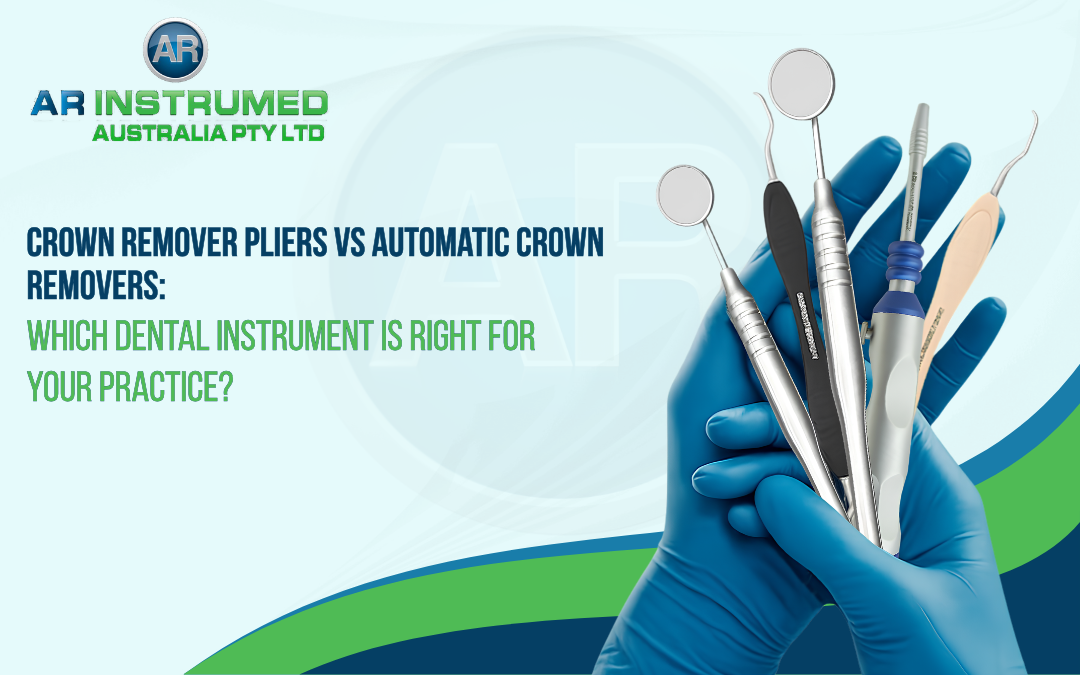
Removing a crown or bridge is rarely the glamorous part of prosthodontic work, but the instrument you reach for affects control, chair time and how smoothly the appointment runs. For most practices, the choice comes down to two families of tools: manual crown remover pliers and automatic crown removers.
This guide compares both, so you can match the instrument to your clinical workflow. It also covers what to check before you buy crown remover pliers in Australia or order for a group practice.
For a broader overview of crown removal instruments, see our earlier guide: Crown Removal Instruments: Essential Tools for Dental Practices in Australia .
Crown Remover Pliers vs Automatic Crown Removers: What's the Difference?
Quick answer: Crown remover pliers (also called crown remover forceps) are hand-operated instruments that grip, hold or separate a restoration. Automatic crown removers are tip-based instruments that use a mechanism to deliver controlled force to the crown, rather than relying on the operator’s grip alone.
Which is better? Neither is universally better. The right choice depends on the type of restoration, practitioner preference, workflow and how often the instrument is used. Many practices keep both.
Crown Remover Pliers
Common applications: Gripping and lifting a loosened restoration, and splitting or separating a crown that needs to be sectioned. Different head angles and lengths suit different areas of the mouth.
Advantages:
- Direct tactile control, because the operator feels and adjusts every movement
- Simple, reusable design with no assembly
- Specialised patterns for anterior, posterior or separating tasks
When they may suit you: When you want hands-on control, when you need a pattern for a specific tooth position, or when you want a dependable manual instrument in every operatory.
Automatic Crown Removers
What they are: Instruments built around interchangeable tips and an internal mechanism. The tip is positioned against the restoration, and the mechanism delivers controlled force when activated, so the operator doesn’t have to generate it by gripping and pulling.
How they differ from pliers: Pliers rely on the operator’s grip and technique. Automatic removers rely on the tip selection, placement and the instrument’s mechanism. The tip is therefore the critical variable.
Advantages:
- Interchangeable tips for different crown shapes and access situations
- A different handling approach that some practitioners prefer for certain cases
- Kits that bundle tips and mounting components
Workflow considerations: You’ll want to confirm which tips are included, how they are changed and stored, and how the instrument is cleaned and sterilised between patients.
When they may suit you: When practitioners prefer a tip-based approach, when you handle varied restorations, or when you want a complete kit rather than individual pieces
Crown Remover Pliers vs Automatic Crown Removers: Comparison
| Comparison | Crown Remover Pliers | Automatic Crown Removers |
|---|---|---|
| Instrument type | Manual pliers or forceps | Tip-based instrument with a mechanism |
| Control | Direct, operator-driven | Mechanism-assisted, tip-dependent |
| Handling | Grip and manoeuvre by hand | Position the tip, then activate |
| Typical use | Gripping, lifting or separating restorations | Removing crowns and bridges using a selected tip |
| Workflow | Ready to use, no assembly | Requires tip selection and care of components |
| Tips/accessories | Rubber retentive inserts on some patterns | Interchangeable tips; mounting kit on some models |
| Practice considerations | Several patterns may be needed | Check tip range and replacement availability |
| Suits | Practitioners who prefer tactile control; every operatory | Practitioners who prefer tip-based handling; practices wanting a complete kit |
Which Crown Remover Is Right for Your Dental Practice?
There is no single correct answer. These factors usually decide it:
- Clinical requirements and type of work: Different restorations and positions call for different instruments.
- Practitioner preference: Comfort and familiarity matter. Ask your team what they already use well.
- Handling and workflow: Consider how the instrument fits your sterilisation cycle and operatory setup.
- Frequency of use: High-volume practices may justify more than one pattern or a spare kit.
- Budget: Compare the cost of a complete kit against individual instruments, and consider replacement tips.
- Tips and accessories: If you choose an automatic remover, check the tip range.
A practical starting point for many practices is one reliable set of pliers plus one tip-based remover. This lets clinicians choose per case. Final technique and instrument selection remain a clinical decision for the practitioner.
What to Look for When Buying Crown Removal Instruments
- Construction and material: Look for stated stainless steel specifications on the product page, not just general claims.
- Ergonomics and precision: Handle shape, spring action and tip design affect control. Where possible, evaluate the instrument in hand.
- Durability: Instruments that handle repeated use and sterilisation cycles reduce replacement costs over time.
- Tips and accessories: Check that tips and parts are available separately.
- Maintenance and sterilisation: Confirm the instrument can be cleaned and sterilised in line with your infection control procedures and the manufacturer’s instructions for use.
- Supplier reliability: Check product information, support and turnaround.
- Range and wholesale options: If you equip multiple surgeries, look for a supplier with a broad range and bulk or wholesale pricing.
Whatever you buy, confirm that the instruments are appropriately listed for supply in Australia and that your sterilisation protocols follow current national infection control guidance. Our dental instruments guide covers this in more detail.
Ready to compare? Browse the full Crown Remover Dental Instruments Range and choose the instrument that fits your technique.
Crown Removal Instruments for Australian Dental Practices
Australian practices vary widely. A single-dentist clinic in regional NSW has different needs from a multi-surgery group in Sydney or a teaching institution. Some prefer a compact set of dependable manual pliers. Others standardise on a complete automatic kit across every room.
Sourcing locally matters too. Practices across Sydney and NSW benefit from a supplier who can answer product questions and supply additional tips or replacements without long lead times.
Sourcing locally matters too. Practices across Sydney and NSW benefit from a supplier who can answer product questions and supply additional tips or replacements without long lead times. AR Instrumed Australia supplies dental instruments, including crown removal tools , crown remover forceps and other prosthetic instruments, to Australian dentists and dental businesses.
Why Choose AR Instrumed?
AR Instrumed is a dental instrument supplier and manufacturer with a dedicated crown remover category within its prosthetics range. It covers crown remover pliers, automatic and tip-based crown removers, universal crown removers and crown spreader pliers, so you can compare instrument types in one place.
The range suits:
- Individual dentists and dental practices selecting instruments for their own technique
- Clinics and hospitals equipping multiple surgeries
- Laboratories and dental institutions needing prosthetic instruments
- Distributors, dealers, importers and resellers looking for a dental instruments supplier in Australia
- Wholesale and B2B buyers with bulk requirements
Explore the wider range of dental instruments or contact AR Instrumed to discuss your requirements.
Frequently Asked Questions
What is the difference between crown remover pliers and automatic crown removers?
Pliers are manual instruments that grip or separate a restoration. Automatic crown removers use interchangeable tips and a mechanism to apply controlled force. The best choice depends on the case and the practitioner’s preference.
Are crown remover pliers suitable for dental practices?
Yes. They are a standard manual option, available in different patterns such as angled or incisor styles. Practices often keep several for different situations.
When should a dentist use an automatic crown remover?
That is a clinical judgement for the practitioner. Automatic removers are generally chosen when a tip-based approach suits the restoration and the clinician’s technique.
How do I choose the right crown removal instrument?
Consider the restorations you handle, clinician preference, handling, sterilisation workflow, frequency of use, budget and available tips. Many practices stock both pliers and an automatic remover.
What should I look for when buying crown remover instruments?
Look for clear material specifications, comfortable handling, durable construction, tip availability, sterilisation compatibility and a reliable supplier with local support.
Where can I buy crown removal instruments in Australia?
You can order crown remover pliers and automatic crown removers directly from AR Instrumed’s online crown remover range, or contact the team for advice.
Get the Right Crown Remover for Your Practice
Dentists and practices: Shop AR Instrumed's crown remover range and choose the pliers or automatic remover that suits your workflow.
Clinics, distributors, dealers and importers: Contact AR Instrumed or submit a Dealer Inquiry for product information, wholesale requirements and partnership opportunities.